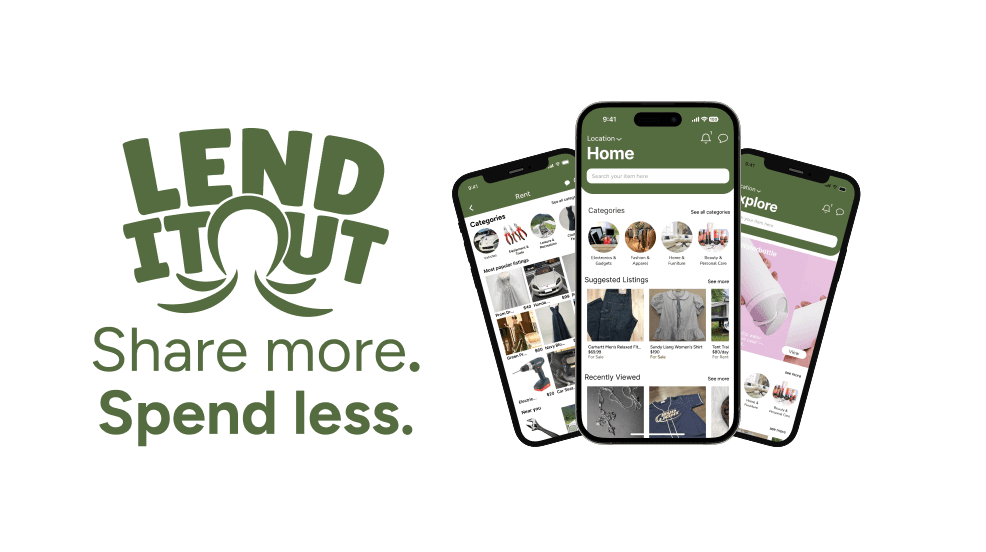
Led UX Research and Design for a Trust-First Rental Marketplace
LendItOut is a peer-to-peer marketplace concept that helps people borrow items for short-term use, then decide whether they want to buy after trying.
Chapter Rail
1/8
My Roles
UI/UX Designer, UX Researcher
Team Size
7
Timeline
January 2025 - May 2025
At a Glance
I helped shape LendItOut from user problem to high-fidelity prototype, focusing on how borrowing, renting, and try-before-you-buy could feel clear, trustworthy, and practical for daily life.
Core Problem
People buy expensive items they only need once or twice.
Main Solution
Localized rental marketplace with optional purchase after trial.
My Impact
Connected research insights to flows, wireframes, and prototype decisions.
Outcome
Functional high-fidelity concept with validated end-to-end marketplace flow.
01 Approach
How I Approached This
Research First, Then Clarify, Then Test
- Research and synthesis: I ran surveys and interviews, then used affinity mapping to identify why people still buy items they rarely use.
- Flow clarity: I shaped the borrow-rent-buy journey so users always understood rental period, cost, and the purchase option.
- Iteration loop: I used usability sessions to improve navigation, listing forms, and trust signals before polishing the prototype.
02 Leadership
My Contribution Areas
UI/UX Designer
I designed marketplace flows for browsing, renting, and trial-to-purchase so the experience stayed simple and predictable.
UX Researcher
I translated user pain points into design priorities, especially around trust, pricing transparency, and one-time-use item needs.
03 Iteration
What Changed Through Testing
Issue: Users hesitated between renting and buying.
Change: Added clearer pricing and timeframe breakdowns in key decision points.
Issue: Trust concerns when lending to strangers.
Change: Increased prominence of reviews, ratings, and item condition details.
04 Challenge
The Core Challenge
People frequently need tools, gear, or specialty items for short periods, but the default option is still full purchase. That creates wasted money, unused clutter, and friction for users who just need temporary access.
Framing question: How might we make temporary access feel as easy and trustworthy as buying?
05 Research
Audience, Persona, and User Stories
- Students and renters with limited storage space.
- Budget-conscious users avoiding unnecessary purchases.
- Occasional-use users who need tools only for short tasks.
- Environmentally-aware users who prefer reuse and sharing.
Primary persona: Alex, 20, lives in a small apartment, needs tools for short-term projects, and wants to save money without committing to full purchases.
Representative user story: As a borrower, I want to rent an item short-term and then choose to buy if it proves useful.
06 Build
Key Features and Rationale
- Rent for a set time: supports one-time needs and avoids unnecessary ownership.
- Try-before-you-buy: reduces buyer's remorse and improves confidence in purchase decisions.
- Peer listings + messaging + reviews: creates trust and accountability between lenders and borrowers.
- Transparent pricing: helps users compare rental cost versus purchase value quickly.
07 Results
What Happened
- Delivered a functional high-fidelity prototype for the marketplace experience.
- Defined a clear end-to-end borrow-rent-buy journey with fewer decision bottlenecks.
- Validated that trust indicators and pricing clarity improved user confidence.
08 Takeaways
What I Took Away
- Trust must be designed explicitly. Reviews, messaging, and condition details are not extras in a peer marketplace.
- Research improves feature prioritization. Real behavior patterns made our roadmap more focused.
- Iteration clarifies value. Repeated testing turned a broad concept into a clear user journey.
- Shared design language matters in teams. Clear artifacts reduced misalignment and sped up decisions.